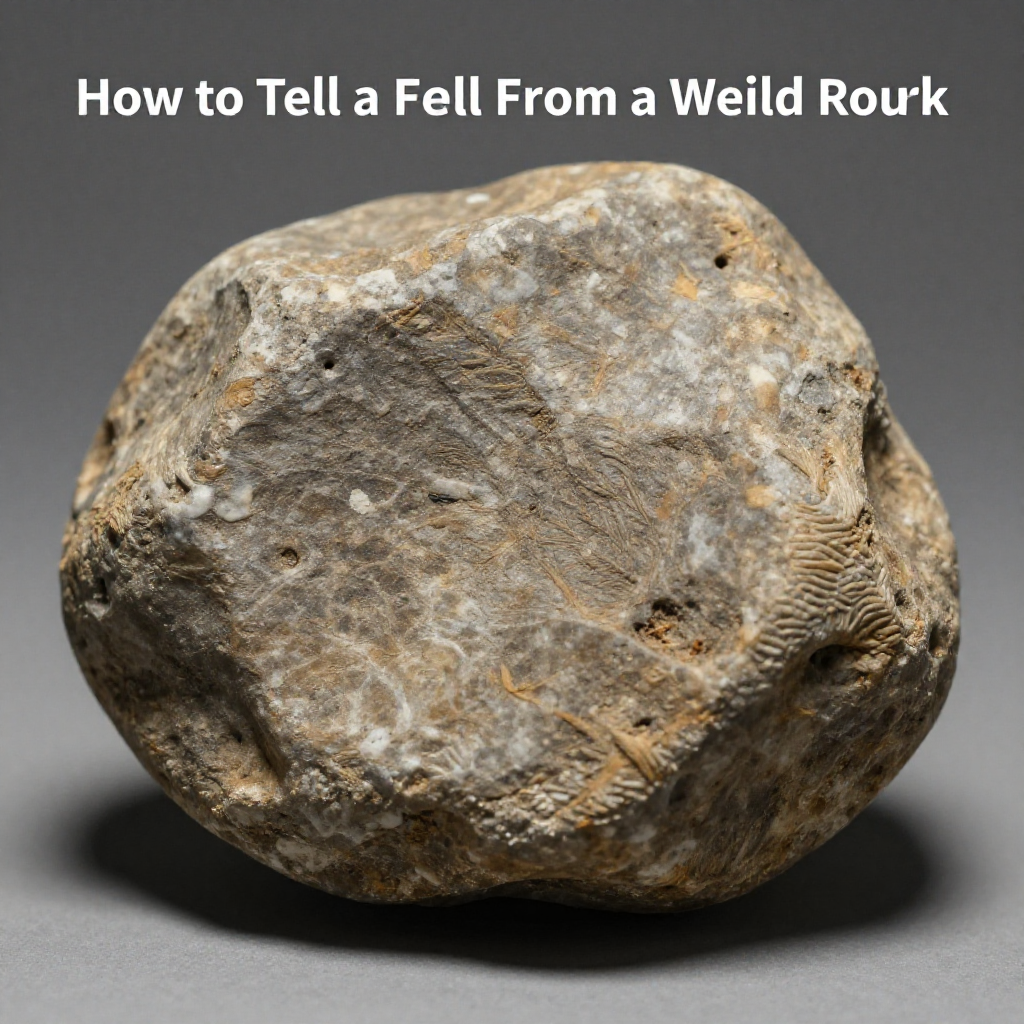
Pick up an odd rock and your brain goes hunting for a story. A radiating pattern reads as a shell. A branching black stain reads as a fossilized fern. Most of the time you're wrong, but not always, and the gap between a real fossil and a very convincing rock comes down to structure you can actually check without a lab.
This isn't a substitute for expert confirmation. Some specimens genuinely need a microscope, a thin section, or a paleontologist's eye. But most backyard finds sort themselves out with a careful look, and knowing what to look for saves you from either tossing a real fossil in the yard or hauling a concretion into a museum.
Look for Structure That Biology Repeats and Minerals Don't
Minerals grow by chemistry: ions stacking in a lattice, layer accreting on layer around a center. Living things grow by biology, and biology leaves patterns that repeat in ways plain crystal growth never bothers to. Three of them are checkable in the field.
Growth Rings, Ribs, and Radiating Patterns
A clam or brachiopod shell adds material in concentric bands as the animal grows, the same way a tree adds rings. Those bands are regular, roughly parallel, and often crossed by fine radiating ribs running from a hinge point outward. Plant fossils show a parallel tell: leaf veins that branch at consistent angles and taper toward the edges, not the erratic branching you get from mineral staining. If the pattern looks like it was built by growth over time rather than deposited all at once, that's a point in the fossil column.
Symmetry That Matches a Body Plan
Bilateral symmetry, a mirror image split down a central axis, shows up constantly in animals: trilobites, fish, leaves, most shells. Radial symmetry, parts repeating evenly around a center point, shows up in corals, sand dollars, and crinoid stems. Minerals can form round or layered shapes, but true bilateral or radial symmetry with matching detail on both sides is a much stronger organic signal, because it implies a body plan, not just a nucleus that accreted material evenly in all directions.
Cellular or Porous Texture Where Bone or Wood Used to Be
Petrified wood and fossil bone don't just look organic, they're often built on the original cellular architecture, replaced cell by cell with silica or calcite. Under a loupe or hand lens, that shows up as a fine, repeating porous texture, sometimes with visible growth rings in cross section for wood, or the honeycomb structure of cancellous bone. Solid, uniform mineral fill with no cellular pattern at all is a point against.
The Rocks That Fool Almost Everyone
Beginners don't usually mistake a plain rock for a fossil. They mistake these three, because all three mimic biology convincingly enough to fool an experienced eye at a glance.
Concretions: The Round Ones With Nothing Inside
A concretion forms when minerals, often calcite or iron oxide, precipitate around a nucleus (a grain of sand, a bit of shell, a burrow) inside sediment before it fully hardens into rock. The result is a rounded or oblong nodule, sometimes with internal layering that looks like it was built by an organism. Crack one open, though, and there's no cellular structure, no repeating pattern, just concentric mineral bands or a solid core. Septarian nodules, with their cracked, calcite-filled interiors, are a classic case: dramatic looking, entirely mineral.
Dendrites: Manganese Playing Plant
Those black, fernlike branches you see on flat rock surfaces are almost always dendrites: manganese oxide (or sometimes iron oxide) that seeped into a crack or bedding plane and crystallized in a branching pattern as the mineral-bearing fluid dried. They form on the surface only, with no depth and no cellular texture underneath, unlike an actual fossil leaf, which has real plant tissue preserved in three dimensions. If the "fern" is flat, thin, and only on the surface with no structure below it, it's a dendrite.
Pseudofossils Carved by Water and Banding
Erosion, mineral banding, and differential weathering can carve or stain rock into shapes that mimic bones, shells, or tracks, sometimes convincingly enough to end up in a museum case labeled "not a fossil." Liesegang banding (rhythmic mineral bands that form as fluids move through porous rock) can look like growth rings. Wind and water can round and groove a rock into something that looks uncannily like a bone. The tell is usually inconsistency: the "structure" doesn't repeat the way biology does, and it often follows the rock's grain or bedding rather than an independent organic form.
What to Do When You Genuinely Can't Tell
Some specimens sit right on the line, and that's normal, not a failure of observation. The right move is patience, not force. Photograph the specimen from several angles, including any broken or naturally exposed surfaces, with something for scale in the frame. Note where you found it and what kind of rock surrounded it, since geologic context (a marine shale bed versus a river gravel bar) tells an expert a lot before they even see the specimen.
Take those photos to a local geology department, a natural history museum's identification desk, or an established fossil ID community. What you shouldn't do is test it yourself with acid or a rock saw. Acid can dissolve a genuine fossil as fast as it dissolves the surrounding limestone, and cutting into an ambiguous specimen can destroy the one structure that would have confirmed it. If it's real, it survived millions of years to reach you intact. Don't be the reason it doesn't survive the identification.
For a broader rundown of what these signs mean and how they fit into overall specimen identification, see our five-test guide to identifying a rock you found. And for a deeper look at fossil types and where they turn up, our fossils field guide is the next stop.